 During April 1975, the State Department organized a two-phased operation: Operation New Life evacuated refugees to centers in the Pacific during the spring and summer of 1975, where they would be medically screened and treated and administratively processed. Operation New Arrivals covered their later movement to the United States and assimilation into American society. Two thousand Army support troops set up a tent city at Andersen Air Force Base, Guam capable of housing more than 50,000 refugees. A center was established at Fort Chaffee, AK and later at Fort Indiantown Gap, PA for U.S. reception. The first of more than 130,000 Southeast Asian refugees evacuated to the United States arrived on 2 May 1975. Over 90,000 received medical care provided by Army nurses at stations along their journey.
The temporary housing facility for Vietnamese refugees erected at Camp Pendleton, CA, May 1975.
Also in April 1975, with Operation Baby Lift, Vietnamese and Cambodian orphans were airlifted to Army bases at the Presidio of San Francisco, Fort Benning, GA, and Fort Lewis, WA as well as the Marine base at Camp Pendleton, CA. The Army provided temporary housing and care for 1,853 of the 2,715 orphans evacuated to the United States before turning them over to voluntary adoption agencies.
The April 1975 refugees were only the beginning. Over the next 25 years, some 3 million people left their homes in the former French Indochinese colonies of Vietnam, Laos, and Cambodia, including 1.75 million Vietnamese land refugees and boat people. They found resettlement, mostly in Western countries and Australia. Of these, the United States East Asian Refugee Admissions Program resettled over 1.4 million Indochinese refugees, including some 900,000 from Vietnam. Countless thousands more lost their lives leaving Vietnam in rickety boats -- only to be preyed upon by pirates, battered by rough seas, and, at times, devastated by an inability to land in friendly territory.
The sailors of the U.S. Seventh Fleet came to the aid of seafarers during the peak years as U.S. naval vessels rescued thousands of Vietnamese "boat people" fleeing political and religious persecution and economic deprivation in the new Socialist Republic of Vietnam.
BY VIK JOLLYTHE ORANGE COUNTY / CAMP PENDLETON — The stark black and white images evoked deep emotions and vivid memories of the days when he helped put up tents, built latrines, hauled clothes and diapers and learned to cook rice.The photographs transported Lewis Beatty back to 1975, to the first real contact with Vietnamese civilians the U.S. Marine had. The two tours of Vietnam during the war that left thousands dead on both sides is not something he likes to remember.
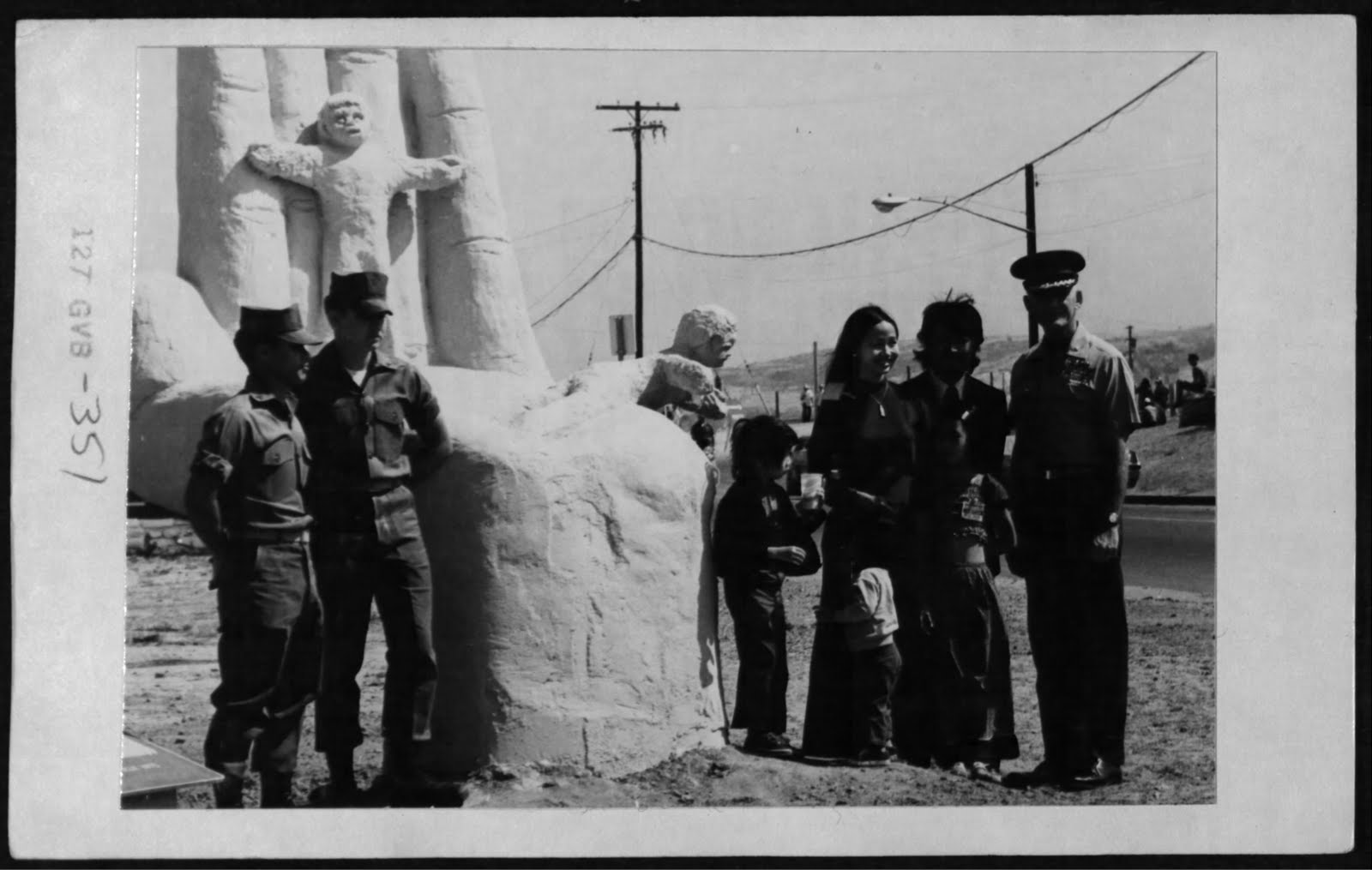
 An exhibit of photos and paintings at Camp Pendleton brings back memories for Hoa Pham of Torrance who was a 22 year-old Vietnamese refugee at the Marine base in 1975 after the fall of Saigon.But this was different. This had tears streaming down the face of the 72-year-old Marine who retired after 23 years in the service. This was a dramatic reminder of the toll war takes on people.The Camp Pendleton Historical Society in conjunction with Oceanside's the "Big Read 2010," on Thursday opened "Images at War's End," an exhibit at the Ranch House on base featuring pictures of the thousands of refugees who found temporary shelter and got their first taste of American cooking here in 1975.The exhibit that moved Beatty includes pictures of the first two weddings of Vietnamese refugees who lived in eight tent cities at the base, when Pendleton got about a 24-hour notice to transform itself into one of four U.S. military installations to house Southeast Asian refugees.The gallery includes pictures of the first Protestant baptismal ceremony at the Camp San Mateo water training tank from May 28, 1975, the day 28 were baptized by a refugee pastor. A toddler and a grandmother playing hide and seek. Women doing laundry and children at play. Singer Rosemary Clooney entertaining. Then First Lady Betty Ford stopping by to visit with former Vietnamese Vice President Nguyen Cao Ky.
 The images, shot by Marine photographers, have surfaced in the past but not as a full collection open to the general public.The gallery, which also displays refugee camp paintings by then Col. Charles Waterhouse, is a poignant window into where the largest Vietnamese population outside of Vietnam got its start in America.Pendleton was the first base in the United States to provide accommodations for Vietnamese evacuees during the U.S. military's 1975 relocation effort, Operation New Arrivals.More than 50,000 Southeast Asian refugees – a majority of them Vietnamese – came to the base as part of the largest humanitarian airlift in history. From the base, refugees resettled across the United States, including the biggest chunk of the immigrant population in Little Saigon in Westminster.
 Phan Dang of Vista, then 27, arrived here May 21 through a circuitous route, she and her two siblings and mother shuttled to American bases just days before the fall of Saigon and ending up at the former El Toro Marine Corps Air Station before arriving by bus to Pendleton at 2 a.m.Dang's brother, a South Vietnamese solider, went missing weeks before her family's departure and is presumed dead. She used to work for the U.S. Department of Defense in Bien Hoa, so her family was evacuated April 24, 1975.Her family arrived at Pendleton with their life's belongings stuffed in two sacks that used to hold rice -- some photos, towels and sheets packed by her mom, a pair of scissors.After a month at the camp, her family was sponsored by Beatty's commanding officer and so they got to know Beatty as well.On Thursday, Dang and her sister, My – who was only 12 when she got to Pendleton – embraced the Marine, with whom they have kept in touch."We felt happy that we were here," Dang recalled of her family's time at the base."I can picture the camp," she said standing next to a painting at the Ranch House portraying camp site # 8, where her family found temporary shelter in one of the tents but little privacy because it slept alongside about half a dozen strangers on cots. "All I wanted to do was keep my family warm."My got her first taste of hamburgers on base and recalled speaking no English when she and her brother enrolled in school, where they quickly picked up the new language.For Beatty, who lives in Oceanside, the gallery takes him to his days working at the tent city, where he and his wife also sponsored two sisters.During the Vietnam War "we saw things that no person should ever see," he said.Then, after a long pause to collect himself, he added: "Here it was joy. In their kids, I could see my kids ... The hard times those people had to go through to assimilate into our society."The refugees coming to America didn't affect the way Beatty perceived the war that claimed 58,000 Americans and 300,000 South Vietnamese lives."That was my job," he said, "I really didn't look at whether it was right or wrong. But when (the refugees) came here you looked at the little kids' suffering because of what the grown-ups had done ... It really gets to your psyche. You change your attitude about people in general."The Pendleton exhibit will run through September.
Contact the writer: 949-465-5424 or vjolly@ocregister.com




 During April 1975, the State Department organized a two-phased operation: Operation New Life evacuated refugees to centers in the Pacific during the spring and summer of 1975, where they would be medically screened and treated and administratively processed. Operation New Arrivals covered their later movement to the United States and assimilation into American society. Two thousand Army support troops set up a tent city at Andersen Air Force Base, Guam capable of housing more than 50,000 refugees. A center was established at Fort Chaffee, AK and later at Fort Indiantown Gap, PA for U.S. reception. The first of more than 130,000 Southeast Asian refugees evacuated to the United States arrived on 2 May 1975. Over 90,000 received medical care provided by Army nurses at stations along their journey.


 UNITED STATES MARINE CORPS


